

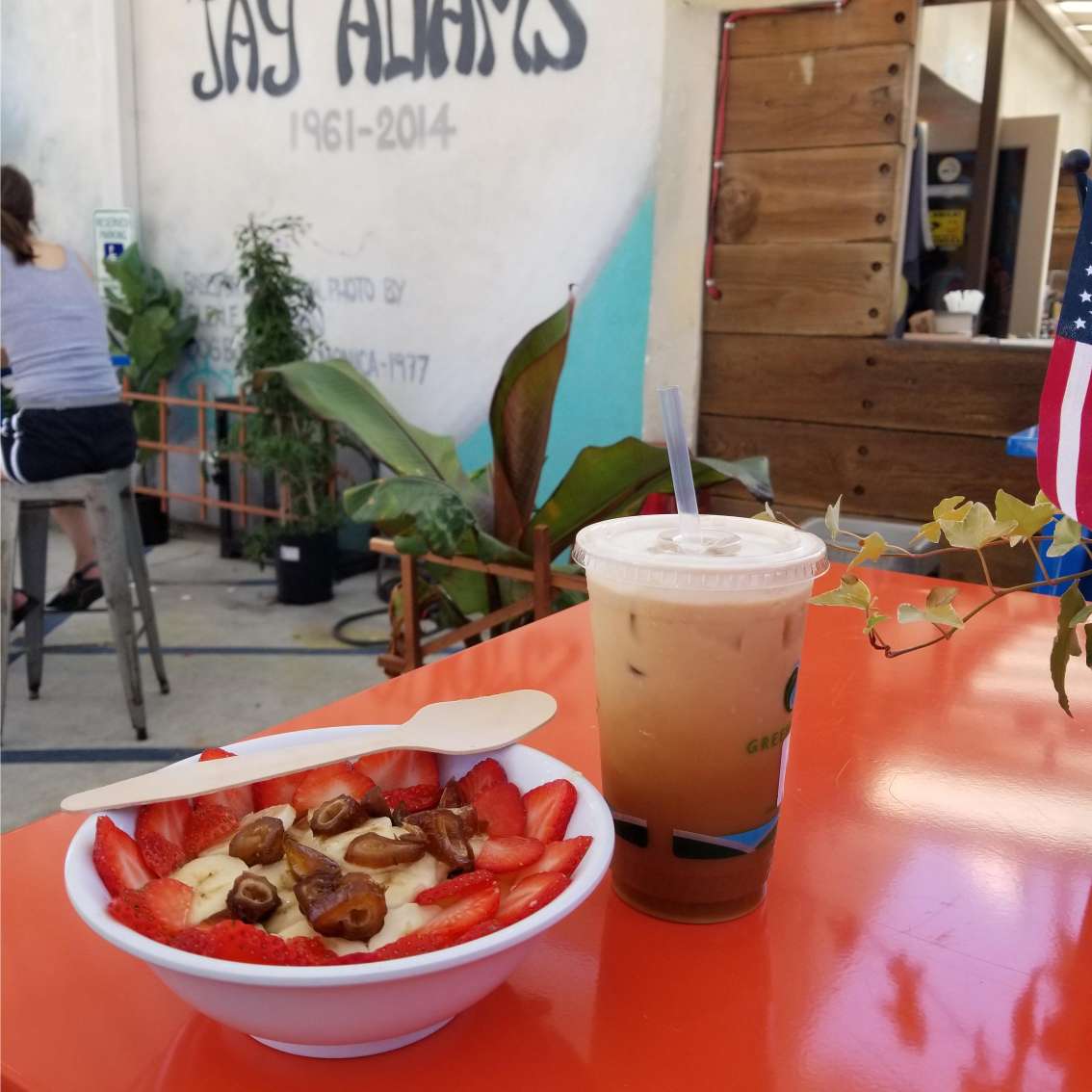
A Place That Was Never Just Coffee
There’s something different in the air around the corner of Main Street and Bay Street in Santa Monica. It’s not just ocean breeze—it’s legacy. It’s history. It’s rebellion laced with espresso. Some say the best cup of coffee in Santa Monica.
Dogtown Coffee isn’t just a coffee shop. It’s a tribute, a time capsule, and a launchpad all at once. It lives inside the old Zephyr surf shop—the sacred grounds where the Z-Boys ignited a revolution. And somehow, nearly fifty years later, it still feels like a flame flickering with the same energy that gave birth to modern skateboarding.
Walk in for a latte, and you’ll feel it: that gritty, soulful, saltwater-soaked spirit that refuses to be silenced by gentrification, filters, or fad cafés. This isn’t nostalgia—it’s evolution. Dogtown Coffee has figured out how to do the impossible: bottle up the punk rock surf-skate rebellion of the ’70s and serve it fresh daily in a modern, neighborhood-loving, community-rooted experience.
This is the story of how Dogtown Coffee became more than a café. It’s the heart of Santa Monica and Venice—still skating, still dreaming, and still caffeinated.
Where It All Began: From Concrete Waves to Coffee Beans
To talk about Dogtown Coffee is to talk about a movement. One that started in the 1970s when a group of teenage surfers—Tony Alva, Jay Adams, Stacy Peralta—turned abandoned Santa Monica swimming pools into skate bowls and transformed Venice Beach’s decaying boardwalk into the birthplace of vertical skateboarding.
They weren’t just skating; they were redefining gravity. They didn’t follow the rules; they made new ones.
And right there, on Bay Street, was the Zephyr surf shop. It wasn’t just a business—it was the clubhouse. The training ground. The sacred space where wood, wheels, and saltwater met art, attitude, and brotherhood.
When Zephyr eventually closed, many worried that the soul of Dogtown would fade. But instead of disappearing, it brewed into something else—Dogtown Coffee.
Keeping the Spirit on Tap
Dogtown Coffee didn’t come in to erase the past. It came in to protect it. Celebrate it. Keep it warm like a fresh-baked breakfast burrito on a cool Venice morning.
You don’t hang vintage surfboards on the wall unless you mean it. You don’t paint your doors with graffiti unless you live it. You don’t serve your community unless you love it.
The interior is a living museum that doesn’t need velvet ropes or museum plaques. The original Zephyr shop energy still hums in the walls, now joined by the hum of espresso machines and the sound of MacBooks tapping beside longboards leaning by the door. You’ll find students and surfers, tech workers and tourists, local legends and future icons—all hanging out under the same roof.
That’s Dogtown’s greatest trick: it didn’t just hold onto the old-school attitude—it evolved it. This isn’t a shrine; it’s a living, breathing outpost of culture.
Fueling the Community, One Cup at a Time
Dogtown Coffee does what so few trendy cafés try—and even fewer pull off. It isn’t about pretending to be cool. It’s about being real.
The coffee? Excellent. Organic beans, local roasters, specialty drinks that rotate with the seasons. The food? Equally legit. Acai bowls so vibrant they rival the Venice sunsets. Breakfast burritos that belong in an Olympic event for best hand-held meals on earth.
But it’s not the food that’s the secret ingredient. It’s the way Dogtown has become an anchor for the neighborhood.
Skaters still walk through the doors with sand on their shoes. Cyclists stop in before hitting the Strand. Writers tuck into corners with open notebooks. Baristas know regulars by name—and by order.
Dogtown is a community in the truest sense. Not curated. Not choreographed. Just people, good coffee, and vibes that refuse to fade.
A Haven for Artists, Surfers, and Seekers
If you’ve ever walked through Venice, you’ve seen the murals. The skateparks. The boardwalk performers. The endless stream of people looking to express something—to feel something real.
Dogtown Coffee is a magnet for those types. Maybe it’s the energy of the location. Maybe it’s the stories soaked into the walls. Maybe it’s just because great coffee brings great people together. Whatever the magic is, it’s working.
Local musicians often stop by before a show. Skateboarders film trick lines just outside the shop. There are days when you might catch a quiet nod from Tony Alva himself, cruising by on his board like he never left.
And in many ways, he never did. Because Dogtown Coffee is the physical proof that the movement he helped create is still alive—and still rolling.
Tourists Come for the Coffee. Locals Come for the Legacy.
There are a lot of coffee shops in LA. But none of them sit on holy ground quite like this.
For tourists, it’s an unexpected slice of history. They come for the iced coffee but leave with a better understanding of what Santa Monica and Venice mean. This isn’t just beach-town America. This is counterculture capital. This is where things start, often with no plan and no permission.
For locals, Dogtown Coffee is home base. A place where you can grab your morning brew, talk surf reports, meet up with a friend, or just sit solo and soak it all in.
It’s rare to find a place that can be both a landmark and a hangout. But Dogtown does it—and makes it look effortless.
The Spirit That Won’t Quit
You can’t talk about Dogtown Coffee without talking about persistence.
The original Z-Boys took scraps and broken boards and turned them into something unforgettable. Today, Dogtown Coffee carries that same attitude. No matter what’s happening in the world—real estate battles, city changes, pandemic curveballs—Dogtown stays open, honest, and true.
It’s the kind of place that doesn’t water down its vibe for popularity. It’s the kind of brand that respects its roots and grows upward from them—not away from them.
It isn’t just inspired by Dogtown—it is Dogtown.
Why It Still Matters in 2025
We live in an age where authenticity is rare and vibes are often manufactured. But Dogtown Coffee proves that when you build something on real history, real community, and real passion, people will respond.
It matters that Tony Alva still skates through these streets. It matters that kids still carve curves in the Venice skatepark, dreaming of greatness. It matters that there’s a coffee shop honoring those dreams—fueling them, preserving them, and passing them to the next generation.
Every latte served at Dogtown Coffee is brewed in the same space that once housed a youth movement that changed the world. That’s not branding. That’s legacy.
Dogtown Coffee: Not Just a Shop—A Symbol
Dogtown Coffee isn’t successful because of flashy gimmicks. It’s successful because it gets it.
It understands the pulse of Santa Monica and Venice. It understands that the soul of Dogtown wasn’t just about skateboards—it was about breaking rules, building culture, and creating something from nothing.
That’s what the original Z-Boys did with wheels.
That’s what Dogtown Coffee does with espresso.
And as long as that old Zephyr building stands, as long as boards keep rolling down Bay Street, and as long as people crave something a little more real, Dogtown Coffee will be there.
Keep Rolling, Keep Brewing
Santa Monica and Venice will keep changing. Skylines will rise. Rents will soar. Trends will come and go.
But some things are just too strong to fade.
Dogtown Coffee is a reminder that history doesn’t have to sit in the past. It can pour fresh into your morning, toast hot in your burrito, and hang on the wall right behind the counter.
It lives on in every young kid gripping their first board. It rides in every carve made down Ocean Park Boulevard. It sips quietly between skaters-turned-entrepreneurs, creatives on laptops, and surfers heading out after sunrise.
Dogtown Coffee didn’t just honor the past.
It lit the torch.
And it’s still burning bright today.